


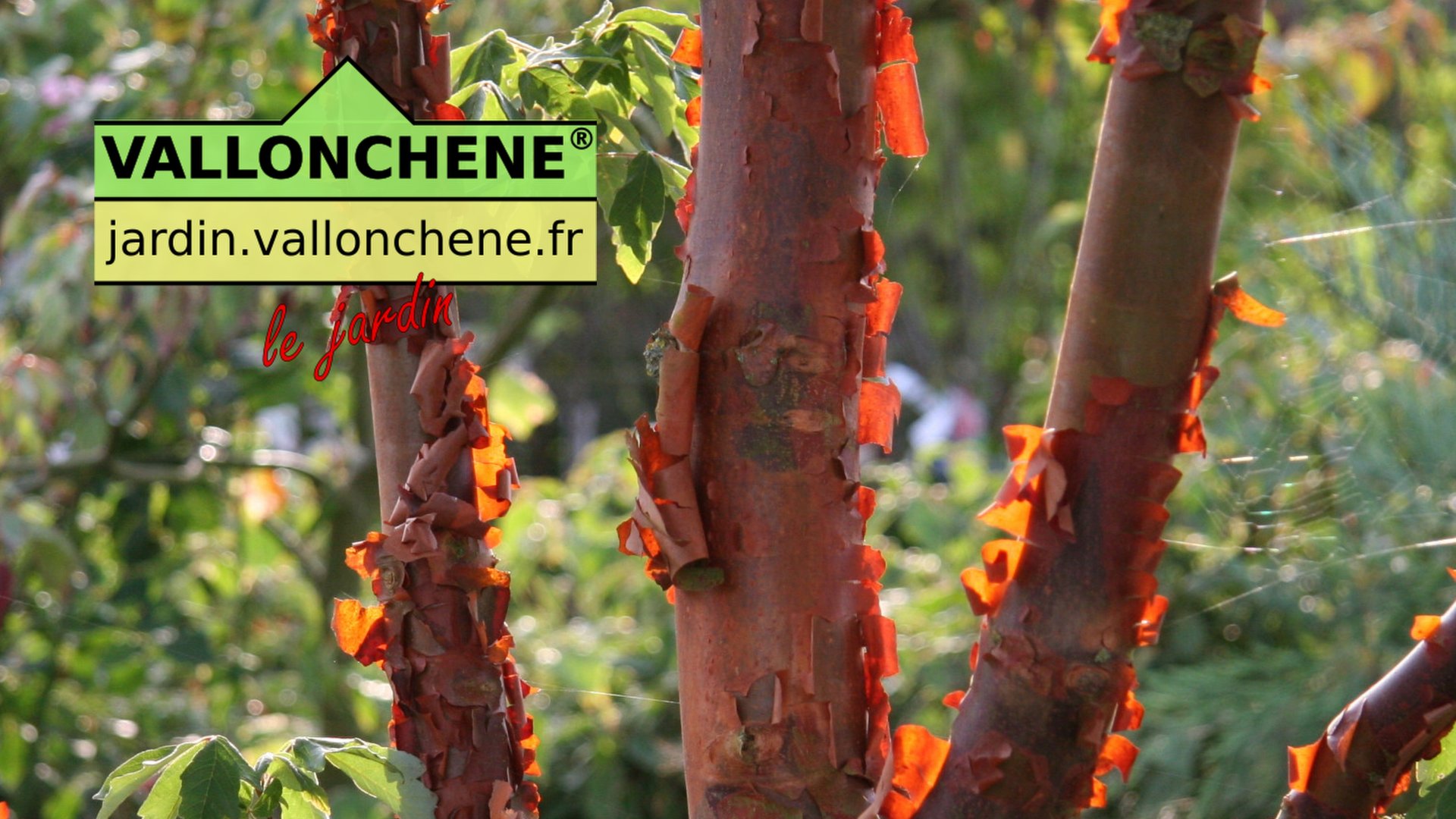
Welcome to Jardin de Vallonchêne. Imagine a tree that lights up under the sun’s rays, adorned with copper-colored bark peeling off like fine ribbons of tissue paper. Today, we present the ACER griseum, an exceptional maple that will offer your garden spectacular appeal throughout the year.
Spectacular bark and exceptional foliage
What makes the ACER griseum world-renowned is its magnificent bark, the color of which ranges from light copper to dark bronze. The outer bark exfoliates naturally in thin papery layers (in large irregular shreds), a natural mechanism that should never be confused with a disease. This trait also helps differentiate it from the ACER triflorum, whose peeling is much more vertical and regular. When the light of the rising or setting sun shines through these shreds, the trunk seems to catch fire, revealing a new, smooth, shiny, deep mahogany-brown bark underneath.
Its foliage is just as remarkable. Unlike classic Japanese maples, it features trifoliate leaves (with three leaflets) with delicately toothed edges, offering a very graphic structure. A very healthy green from spring to summer, the foliage takes on flamboyant yellow, orange, and red colors in autumn. In late summer, the tree produces impressive seeds that add an extra decorative element. Even in winter, once the leaves have fallen, its rounded habit reveals a highly aesthetic structural design.
History and preservation of a rare species
In the wild, this maple is native to the mountain forests of central China, where it grows between 1,500 and 2,000 meters in altitude. It was in 1892 that the missionary and botanist Father Paul Guillaume Farge discovered the species. It was then introduced to the West at the very beginning of the 20th century by the famous plant hunter Ernest Henry Wilson.
Today, the ACER griseum has become a very rare and threatened species in its natural habitat. Its cultivation in our gardens and its propagation in nurseries therefore play an essential role in preserving this exceptional botanical heritage.
Our cultivation and planting tips
The ACER griseum is a tree with sensible growth (it reaches about 2 to 3 meters in height after ten years) and is very easy to cultivate.
- Exposition : Placez-le au plein soleil ou à mi-ombre. Pour mettre son écorce en valeur par un effet de rétro-éclairage, choisissez un emplacement où il sera illuminé par l’arrière lors des soleils levants ou couchants.
- Tolerance and Soil: Unlike some highly demanding maples, it accepts all types of soils (light, normal, or heavy). Its pH adaptation is very broad: it tolerates acidic, neutral, and calcareous soils equally well.
- Hardiness and Resistance: It is extremely hardy and has withstood temperatures below -20°C in our garden. A major asset: unlike Japanese maples, the ACER griseum is not at all susceptible to Verticillium wilt (a fungus that is usually fatal to them).
- Watering: It thrives in environments ranging from cool to dry. Do not forget to water young plants regularly during their first two years, especially during dry periods (outside the winter season).
- Planting: The most crucial point when planting in the ground is not to bury the root collar (the transition zone between the roots and the trunk). The start of the roots must remain visible throughout the life of the tree.
- Pruning: Restrict your intervention to winter pruning of the fine branches located inside the canopy. If you have a very small garden, you can grow it as a multi-stemmed coppice (with multiple branches from the base) to slow down its growth even further.
Which plants to pair with your maple?
Since the decorative appeal of the ACER griseum is permanent and particularly dazzling in the light, we recommend planting ground covers with dark or evergreen foliage at its base to create a strong contrast. Here are some excellent choices for creating a true focal point in your garden:
THUYA plicata ‘Whipcord’, an excellent solution for maintaining low vegetation:
https://www.vallonchene.fr/produit/thuya-plicata-whipcord/
PINUS strobus ‘Connecticut Slate’, whose fairly horizontal habit will contrast nicely:
https://www.vallonchene.fr/produit/pinus-strobus-connecticut-slate/
CRYPTOMERIA japonica ‘Little Champion’, which grows in a regular and rounded shape:
https://www.vallonchene.fr/produit/cryptomeria-japonica-little-champion-cedre-du-japon/
CORNUS ‘Kelsey’s Gold’, which also offers a naturally rounded habit:
https://www.vallonchene.fr/produit/cornus-sericea-kelsey-s-gold-rosco-cornouiller-soyeux-nain-jaune/