


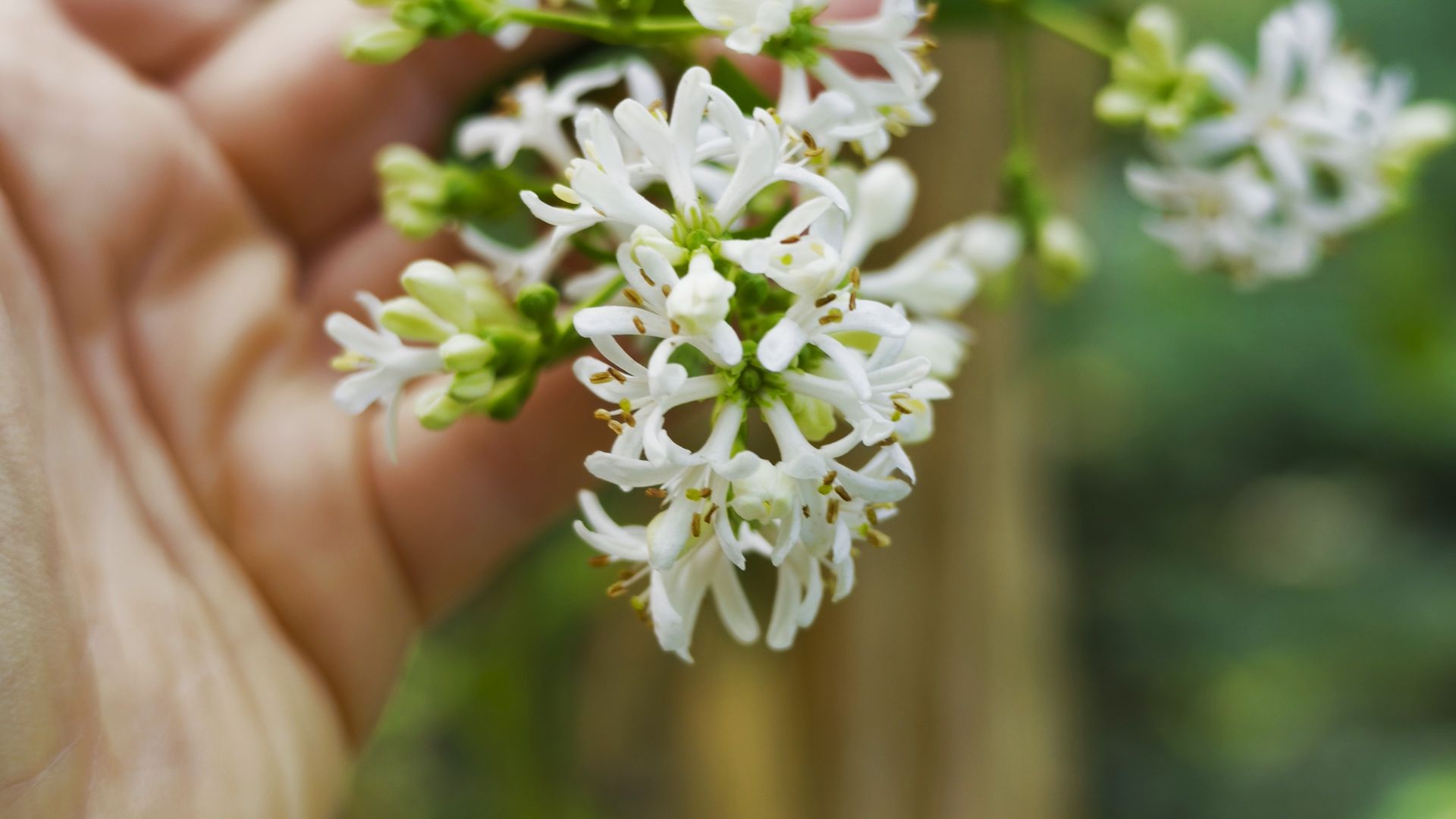
HEPTACODIUM miconioides, sometimes called “Seven Son Flower”, is a shrub or small tree belonging to the honeysuckle family that brings continuous life to the garden throughout the year. Discovered in China in 1907 by plant hunter Ernest Henry Wilson, then studied and named by botanist Alfred Rehder in 1916, this shrub then faded into obscurity for decades. Having become extremely rare and threatened, it was saved at the last minute thanks to seeds collected during a Sino-American expedition in 1980.
Planting this shrub means welcoming a true survivor offering a permanent show:
- Foliage (Spring): Its dark green leaves, curved in a half-heart shape, are traversed by three deep parallel veins recalling the tropical plant Myconia (hence its name miconioides).
- Melliferous flowering (Summer): In August and September, it is covered with panicles of small, star-shaped white flowers releasing a powerful jasmine scent. This abundant flowering is a crucial feast for bees, bumblebees, and butterflies.
- Autumn illusion: Once the white petals have fallen, the calyx elongates and takes on a spectacular cherry red tint that intensifies with the first cool nights, giving the illusion of a flamboyant second flowering.
- Graphic bark (Winter): Its bark naturally peels off in strips, decorating the garden in the middle of winter.
Culture and Care Awarded the RHS AGM, the HEPTACODIUM is incredibly robust, tolerating limestone in well-drained soils and withstanding temperatures down to -20 °C. A very sunny exposure is recommended to obtain an intense red on the autumn calyxes. Grown in containers to avoid severed roots, it can be planted all year round without stress. It requires long and deep watering to force the root system to go down and seek coolness, supplemented by a good organic mulch.
To highlight its peeling bark, it is possible to perform a thinning prune with secateurs (ideally in winter) by removing small damaged or crossing wood from the base in order to make the structure translucent. However, this pruning should not be systematic or go too high, in order to let the wood thicken to resist the wind and avoid premature aging.
If you wish to adopt this botanical marvel, our magnificent nursery-grown specimens are available on our online shop: 👉 https://www.vallonchene.fr/en/product/heptacodium-miconoides/
In garden news: Discover the majestic autumn colors of our TAXODIUM distichum ‘Nutans’ in our previous video here.